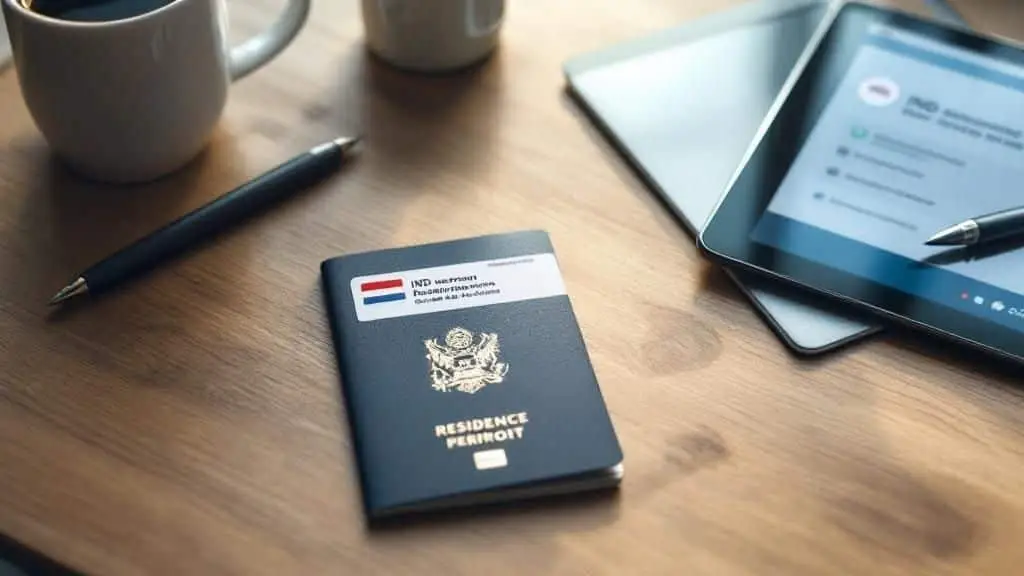
A Dutch permanent residence permit gives you an indefinite right of residence, but the card that proves it has an expiry date. It is usually valid for five years, or ten years for the permanent residence document of an adult EU citizen, and has to be renewed when it expires. That renewal replaces a document; it is not a new application for a status. The main exception: your right itself can still be lost, for example after a long absence from the Netherlands or the EU, or after a serious criminal conviction.
Below we explain what the renewal involves, how you apply to the Immigration and Naturalisation Service (Immigratie- en Naturalisatiedienst, IND), what happens while you wait and what to do if something goes wrong. The Dutch term you will see on forms and letters is verlending verblijfsvergunning on bepaalde tijd, or more precisely the renewal of the residence document.
What does renewing a permanent residence permit actually mean?
It means the IND issues you a new residence card with your current details and a new photo. Your right to live and work in the Netherlands indefinitely stays as it is.
A permanent residence permit is granted for an indefinite period. Only the physical card has an expiry date. When that date approaches, you ask the IND to issue a new document. The IND describes this as renewing the residence document because its validity is ending.
This applies to several types of permanent residence: the permanent regular residence permit, the EU long-term resident permit (in Dutch: langdurig ingezetene-EU), the permanent asylum residence permit, permanent residence for EU citizens and their family members, and permanent residence under the Brexit Withdrawal Agreement. The route for all of them is broadly the same.
Once you hold permanent residence, you are free to work in the Netherlands without a separate work permit. You have almost the same rights as a Dutch national, apart from voting in national elections and certain government positions. Renewing the card does not change any of that.
How does the renewal differ from extending a temporary permit?
With a temporary permit the IND checks again whether you still meet the conditions for your stay. With a permanent permit that check does not return: your right of residence is already established.
A temporary residence permit is linked to a purpose, such as work as a highly skilled migrant, study or living with a partner. When you extend it, the IND looks at your income, your employer, your relationship or your study progress. If a condition is no longer met, the extension can be refused.
A permanent residence permit is not linked to such a purpose. When you renew the document, the IND checks that you are the holder of an eligible permanent permit and that you have lawfully resided in the Netherlands. The table below sets out the main differences.
| Anya | Renewal of a permanent residence document | Extension of a temporary permit |
|---|---|---|
| nzube | Replacing the card whose validity is ending. | Continuing a stay for a specific purpose, such as work or study. |
| Level of scrutiny | Limited: identity, the permit you hold and your lawful residence. | Full: all conditions of the permit are checked again. |
| Isi ihe achọrọ | You still hold permanent residence and live in the Netherlands. | You still meet every condition of the original permit. |
| Your underlying status | Indefinite; not reassessed through the renewal. | Temporary; must be shown to continue. |
That does not mean the IND ignores your situation. If the IND learns during the process that you have moved abroad or have been convicted of a serious offence, it can examine whether your permanent residence should be withdrawn. That is a separate procedure, with its own decision and its own right of objection.
Can you lose permanent residence?
Yes, but not because the card expires. Permanent residence can end through a long absence or on public order grounds.
For the permanent regular residence permit, the IND can withdraw the permit if you move your main residence outside the Netherlands. This follows from Article 22 of the Aliens Act 2000 (Vreemdelingenwet 2000, Vw). A holiday or a temporary posting abroad does not count as moving your main residence. What matters is where the centre of your life is: your home, your work, your registration and your family.
How long can you stay outside the Netherlands?
For a regular permit, the IND assumes you have moved your main residence after more than six months in a row abroad within one calendar year. The same applies after more than four months in a row abroad in each of three consecutive calendar years, if the centre of your life has also moved abroad. An absence you did not choose, for example through force majeure, is treated differently.
For the EU long-term resident permit the rules come from the EU Long-Term Residents Directive (2003/109/EC). You can lose this status if you stay outside the EU, the EEA and Switzerland for more than twelve consecutive months, or if you live elsewhere in the EU, the EEA or Switzerland for more than six consecutive years. If you are planning a long stay abroad, check in advance which type of permit you hold. The difference can decide whether you keep your status.
A serious criminal conviction can also lead to withdrawal. The IND weighs the seriousness of the offence against the length of your lawful stay and your ties to the Netherlands. The longer you have lived here, the heavier the offence must be.
What should you check before you apply?
Check three things: a valid passport, your main residence in the Netherlands and correct details in the municipal records. Most delays start with one of these.
First, your passport or other travel document must be valid. The IND places your details from that document on the new card. If your passport expires soon, renew it first. An expired passport can bring the application to a stop.
Second, you must still have your main residence in the Netherlands. This is the place where your life is centred: where you live, work and are registered. It is more than a postal address. If you have spent long periods abroad in recent years, look at the rules on losing permanent residence above before you apply.
Third, the IND relies on the Personal Records Database (Basisregistratie Personen, BRP). Your address, name, date of birth, marital status and passport details must be correct there. If your application and the BRP do not match, the IND will ask you to sort it out first, which costs time.
If you find an error, go to your municipality (gemeente) and have it corrected before you submit the renewal. Do not assume a small mistake will be overlooked. For people who first came to the Netherlands for work, study or family reasons, our overview of Iwu mbata na ọpụpụ Dutch sets out how the different permits fit together.
Before you apply, run through this short list:
- Is your passport valid, and will it stay valid during the procedure?
- Have you kept your main residence in the Netherlands without long interruptions?
- Are your details in the BRP correct and up to date?
- Has anything happened, such as a criminal conviction, that could affect your residence status?
If the answer to the last question is yes, get advice before you submit anything. A renewal can bring such matters to the IND’s attention, and it is better to know your position in advance.
How do you apply for the new document?
You apply online with DigiD or by post with the IND’s paper form. Online is usually quicker because you pay straight away and upload your documents as you go.

The IND’s page on renewing a permanent residence document is the starting point. It lists which permit types qualify and links to the online application and to the paper form (form 6013 at the time of writing).
For the online route you need DigiD with SMS verification or the DigiD app. The online form guides you through each step and lets you upload copies of your documents. You then pay the fee directly.
For the postal route you download the form, fill it in completely, sign it and send it with copies of your documents. Never send originals. Check every page before posting: a missing signature or an illegible answer can delay the whole application.
Apply in good time, well before your current card expires. That gives you room to deal with surprises, such as a passport that needs renewing or an error in the BRP. The IND usually informs you when your document is about to expire, but you remain responsible for applying.
Kedụ akwụkwọ ị chọrọ?
For a standard renewal the list is short. You normally need:
- the completed application, online or on paper;
- a copy of the photo page of your valid passport;
- a copy of the front and back of your current residence card.
The IND can ask for more in a specific case, for instance if your details have changed or if your card was lost. Always follow the current checklist on the IND website, because the requirements can be adjusted.
Kedu maka ụgwọ ahụ?
The renewal costs a fee, which the IND sets and adjusts periodically. Check the amount on the IND’s fees page just before you apply.
If you apply online, you pay immediately with iDEAL and your application goes into processing straight away. If you apply by post, the IND sends you a letter with payment instructions. Pay as soon as that letter arrives. The IND does not start assessing your application until the fee has been paid.
What happens at the biometrics appointment?
After you apply, the IND asks you to have your biometrics taken: a passport photo, your fingerprints and your signature. These are needed to produce the new card.
The IND’s letter tells you how to make the appointment at an IND desk (IND-loket). Bring the appointment confirmation, your valid passport and your current residence card. Follow the instructions in the letter on what to bring. An incomplete appointment is a common cause of delay, so check the letter the day before.
What happens after you submit the application?
The IND confirms receipt and then assesses your application. By law it must decide within 90 days, a period that can be extended in some cases.

The 90-day decision period for residence applications follows from Article 25 of the Aliens Act 2000. It starts once the IND has received your application. If information is missing or the fee has not been paid, the IND will ask you to complete the file, and that delays the decision. Many straightforward renewals are decided sooner, but plan for the full period.
You can follow the status of your application in the My IND portal (Mijn IND), where you log in with DigiD. This saves you having to call the IND for simple updates.
What if your card expires while you wait?
You keep your right of residence, but you may not be able to prove it. The IND can place a residence sticker (verblijfssticker) in your passport to bridge the gap.
The residence sticker shows that you have applied and are lawfully resident while the IND decides. It also allows you to travel and return to the Netherlands and the Schengen area. You need an appointment at an IND desk to get one, and you must bring your passport.
A sticker is relevant if you have already applied, your current card has expired or is about to, and the IND has not yet decided. Without valid proof you can run into problems with your employer, your bank or at the border. If you plan to travel, arrange the sticker before you leave.
How do you collect your new card?
If the renewal is approved, you receive a letter with the decision. A later letter tells you that your card is ready and at which IND desk you can collect it.
When you collect the card, bring the collection letter, your valid passport and your old residence card. You hand in the old card. An IND official checks your identity, you sign for the new card and the process is complete. The new card again carries an expiry date, and the cycle starts again.
Gịnị ma ọ bụrụ na ihe adịghị mma?
Most problems fall into four groups: a lost or stolen card, a refusal, a delay or incorrect personal data. Each has a clear route.
Your card is lost or stolen
Report the loss or theft to the police first. If it happened abroad, report it to the local police there and ask for an official copy of the report.
You then apply to the IND for a replacement document. The IND has a separate page on a residence permit that has been lost or stolen, with its own form and fee. Include the police report with your application. Until you have the new card, your right of residence itself does not change, but again you may need a residence sticker to prove it.
Your application is refused
Read the decision carefully: the IND must explain its reasons. You can then file an objection (bezwaarschrift) with the IND. In immigration cases you have four weeks to do so. That is shorter than the usual six weeks under Article 6:7 of the General Administrative Law Act (Algemene wet bestuursrecht, Awb), because Article 69 of the Aliens Act 2000 sets a shorter term. The decision states the exact deadline.
A refusal to renew the document of a permanent permit is unusual. When it happens, the reason is often not the card itself but a question about your status: the IND believes you have moved your main residence abroad, or it relies on a criminal conviction. Other reasons can be incomplete or incorrect information in the application.
An objection must set out why the decision is wrong, supported by evidence. If you miss the four-week deadline, the decision in principle becomes final. Our article on an mkpesa ma ọ bụ mkpesa megide mkpebi IND explains the procedure in more detail. If the objection is rejected, you can appeal to the administrative court.
The IND takes too long
If the decision period has passed without a decision, you can send the IND a formal notice of default (ingebrekestelling). After that, the IND has two weeks to decide.
If the IND still does not decide within those two weeks, you can lodge an appeal with the court against the failure to decide on time. The court can then order the IND to take a decision within a set period. This is an effective way to get a stalled file moving, but make sure the decision period has really expired before you act.
Your BRP data are incorrect
If the IND finds a mismatch between your application and the BRP, it pauses the file and asks you to correct it.
This can be a misspelled name, an old address or an outdated marital status. Go to your municipality, have the records updated and let the IND know once this is done. The IND only continues once the data match. Checking your BRP details before you apply avoids this delay altogether.
The table below summarises the first steps.
| nsogbu | Nzọụkwụ mbụ | Document involved |
|---|---|---|
| Card lost or stolen | Report it to the police. | Police report (proces-verbaal) |
| Application refused | Read the decision and file an objection within four weeks. | Notice of objection (bezwaarschrift) |
| Decision period passed | Send a notice of default; after two weeks, appeal to the court. | Ọkwa nke ndabara (ingebrekestelling) |
| Incorrect BRP data | Have the municipality correct the records. | Correction request at the gemeente |
Procedures and forms change from time to time, so always check the current information on the IND website.
Kedu ka o si arụ ọrụ na omume?
For most holders the renewal is a routine step. The questions we see in practice are about timing, travel and a card that has already expired.

When should you start?
Start several months before your card expires. Use that time to check your passport and your BRP data and to gather the documents.
A useful habit is to put a reminder in your calendar a few months before the expiry date. Treat it as the moment to start preparing, not as the moment to submit. If you leave it until the last weeks, a new passport or a correction at the municipality can push you past the expiry date. A gap in your proof of residence can cause practical problems with your employer or bank.
Can you travel while the IND is deciding?
Yes. If your current card is still valid, travel with that card and your passport as usual.
If your card will expire while the application is pending, get a residence sticker in your passport before you leave. A printout of your application receipt is not enough to return to the Netherlands. Travelling with only an expired card and a receipt can lead to problems at the border, and you may be refused boarding or entry.
What if you forgot to renew in time?
An expired card does not end your permanent residence. Your right of residence remains, but you have no valid document to prove it.
In practice that gap can be a nuisance. Your employer may not be able to verify your right to work. You may not be able to return to the Netherlands after a trip abroad. Banks and other institutions may refuse services without a valid identity document.
The solution is to apply as soon as you notice the problem. The procedure is the same as a regular renewal. Take an employee who realises after a holiday that her card expired two months ago: she applies online the same week, asks for a residence sticker and informs her employer. Her status never changed; only the proof was missing.

What does the renewal mean for your work and family?
Nothing changes as long as you can show a valid document. Your employer, your family members and public bodies simply need to see current proof of your status.
Employers in the Netherlands must check and keep a copy of the identity document that shows your right to work. When your card is renewed, give your employer a copy of the new card. If your old card expires before the new one is ready, show the residence sticker or the IND’s letters confirming that your application is pending. An employer who cannot see valid proof may hesitate to keep you on the payroll, even though your right to work has not changed.
Family members do not derive a renewal from your application. Each person with a residence card has their own document with its own expiry date. A partner or child who holds a temporary permit based on family reunification with you must extend that permit separately, and the IND will then assess the conditions for their stay. Check the expiry dates of all cards in the household at the same time, so that no one is caught out.
Other organisations also rely on your card. Banks check identity documents under anti-money laundering rules. Municipalities, health insurers and landlords may ask for proof of lawful residence. A valid card, or a residence sticker while you wait, avoids unnecessary discussions.
Do you need to report changes during the procedure?
Yes. Changes in your situation must be reported, both to your municipality and, where relevant, to the IND.
If you move house while your application is pending, register your new address with the municipality within the usual period. The BRP then passes the new address on to government bodies, including the IND. Make sure that letters from the IND still reach you, because they contain appointments and deadlines. A missed letter can mean a missed biometrics appointment or a missed request for information.
If you plan to move abroad, the question is no longer about the card but about your status. Moving your main residence outside the Netherlands can lead to withdrawal of a permanent regular permit. An EU long-term resident permit has its own absence rules. Before you leave for a long period, find out what the move means for your permit and whether you can return on the same basis later.
If you change your name, for instance after a marriage, or obtain a new passport with a new number, update the BRP first. The IND places the details from your travel document and the BRP on the card, and they must match.
Oge njedebe na usoro ndị ọzọ
Three periods matter: the expiry date of your card, the IND’s 90-day decision period and the four-week objection period after a refusal.
Prepare a few months before the expiry date and apply in good time. Keep your IND letters, because the dates on them determine your deadlines. If you receive a refusal or a letter announcing that the IND is considering withdrawing your permanent residence, act straight away. Such a letter usually gives you the opportunity to respond, and what you say at that stage can decide the outcome.
Na nchịkọta
- Your permanent right of residence is indefinite; only the card expires, normally after five years.
- Renewal replaces the document and does not reassess the purpose of your stay.
- Check your passport, your main residence and your BRP data before you apply.
- The IND must decide within 90 days; a residence sticker bridges the gap if your card expires.
- After a refusal you have four weeks to object; a long absence or a serious conviction can put your status at risk.
Ọtụtụ mgbe Ẹbụp Ajụjụ
Ugboro ole ka a ga-emegharị ikike obibi na-adịgide adịgide nke ndị Netherlands?
Your right of residence is indefinite, but the residence card is normally valid for five years. You apply to the IND for a new document when it expires. You do not have to meet the original conditions of your stay again.
Kedu ihe dị iche n'etiti imegharị akwụkwọ ikike na-adịgide adịgide na ịgbatị akwụkwọ ikike nwa oge?
Renewing a permanent permit replaces the card; the IND does not reassess the purpose of your stay. Extending a temporary permit means the IND checks again whether you still meet all the conditions, such as work, study or a relationship.
Kedụ akwụkwọ m chọrọ iji mee ka ikike obibi m dị ọhụrụ?
Usually the completed application, a copy of your valid passport and a copy of your current residence card. The IND may ask for more in specific cases. Check the current IND checklist and make sure your details in the Personal Records Database (BRP) are correct.
Ogologo oge ole ka IND na-ewe iji kpebie ngwa mmeghari ohuru?
The IND must decide within 90 days, a period that can be extended in some cases. If your card expires while you wait, you can ask for a residence sticker (verblijfssticker) at an IND desk to prove your lawful stay.
Gịnị ka m ga-eme ma ọ bụrụ na a jụ ngwa m maka imegharị ihe?
The decision explains the reasons. You can file an objection (bezwaar) with the IND within four weeks of the date of the decision. If the objection is rejected, you can appeal to the administrative court.
Law & More assists expats, employers and families with residence permits, IND procedures, objections and appeals. Unsure where you stand? Tell us about your situation. We will let you know your options within one working day.
Kedu Law & More enwere ike inyere gị aka na nke a ka akọwara na anyị onye ọka iwu ọpụpụ page.